Introduction
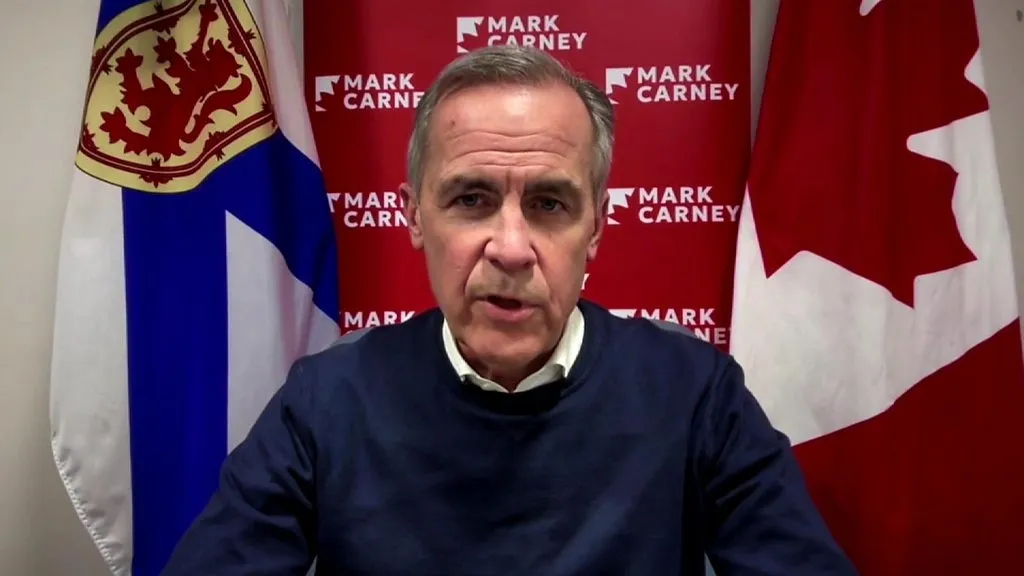
The Federal Liberals have been trying to get this guy to run for years but if you are anything like most Canadians before he appeared on the political scene (presumably emerging from some gold-filled vault) you probably didn’t and still don’t know much about this fella. So I am going to try to answer why the Liberals are obsessed with coronating him and what we can expect from him if (and likely when) he becomes prime minister; even if it is for five minutes.
Who the Hell is Carney Anyway?
Mark Carney is, in case you haven’t heard any news in the last 20 years, the former Bank of Canada Governor who was captain of that ill-fated vessel as it entered the storm known as the 2008 recession. He did well apparently (not that anyone would know because nobody would be willing to occupy Toronto’s Bay Street) and the Canadian economy avoided the major decline that the American economy suffered. After his governorship of the Bank of Canada, the British Empire rematerialized for five seconds and Her Majesty promoted him to run the Bank of England (which speaking of he describes as running an institution that hasn’t realized it doesn’t have an empire anymore). In this role he would be unusually politically active by encouraging the UK not to jump off the ledge called Brexit; presumably by yelling at them “Don’t do it you have so much to live for!”. I’d give him credit for predicting the poor result of Brexit if it wasn’t obvious what the result of leaving the world’s largest economic union was going to be to everyone who is not British and under 100, but c’est le vie we still let old British people vote because of human rights or something. Anyway, he would serve in the role of Governor of the Bank of England until March 2020 when his term would end in the most lucky spot possible if you happen to remember what happened to every central bank immediately after that. He must have done a good job though because former UK prime minister Liz Truss said he was awful which is basically high praise coming from her. After 2020 he played will I won’t I with Justin Trudeau on the issue of joining his cabinet, this I presume greatly annoyed him which I consider an absolute win. Yet despite flirting with politics he has never been an elected official and is firmly a banker.
What do the Liberals Need with a Banker?
Carney is not just any Banker; he is an Anglo-Western-Canadian banker. This means that consulting the record of liberal prime ministers, he is certainly an odd choice on a conceptual level if they plan to win the election. Let me explain: To win as the Liberal Party, you have to win Quebec; to win Quebec, you either have to be a French Liberal Leader or Jack Layton (and unfortunately for the Liberals, Jack is a New Democrat and also dead). So Carney is a risky choice for the Liberals which the risk of is only compounded by the fact that he is an intellectual type likely to suffer the Ignatief effect. If you are unaware of what the Ignatieff effect is, Micheal Ignatieff was an intellectual who also happened to be a black hole of relatability and charisma who ran for Prime minister in 2011 and destroyed the liberal party in the process; the country’s politics have still not recovered (not joking). With these facts in mind, why do the liberals want him and not some seasoned politician? Well that comes down to the fact that he is both the perfect response to the conservative’s new king Pierre Polievre and exactly the kind of guy the Liberals love making their leader.
The Conservatives have been drilling into voters that Justin Trudeau ruined the economy for the past 4 years in preparation for their third try to defeat the Liberal government. Carney is a great response to this because despite the best efforts of the conservatives he refuses to become Justin Trudeau and also happens to be good enough at handling money for Steven Harper to keep him around as Bank of Canada Governor. Also In a tradition going back to Mackenzie King, the Liberals love drafting intellectuals and expert elites when selecting a leader (this is partially the reason they ended out with the train wreck that was Ignatieff). Carney is undeniably an intellectual elite having written several books and has spent his whole career mingling with the Laurentian and international upper crust making him very attractive to the Liberals. There is also the added bonus that he is distant from the party apparatus which gives him among voters who are sick of anyone related in any shape or form to Trudeau. So in short, other than not being a Francophone Carney is everything the liberals look for in a leader.
Is it Enough?
Times are hard and people want change above all else. Canadians are grappling with a high cost of living, low housing supply, climate change, an underperforming economy, low trust in government, and an unpredictable dangerous southern neighbour. John Goheen, a federal liberal candidate, put it best in saying “We are living in extraordinary times. Extraordinary times require extraordinary leaders.”; from this, the central question is does Carney embody an extraordinary leader? Extraordinary has a dual meaning that must be considered, it means both great and unusual depending on context. It is obvious that Goheen probably meant stage times call for great leaders, but it is equally logical to say unusual times call for unusual leaders. This is because a times being unusual implies unusual problems which to be solved need unusual solutions which it follows would require unusual leaders to implement them. It is clear to most Canadians that something desperately needs to change. Change by definition is unusual and what is unusual is exciting. So in summary, Canada needs an exciting weirdo to fix our unusual problems.
Can Carney represent that extraordinary leader in greatness and unusualness? What is more concerning about the prospects of Carney convincing people he stands for meaningful change is his profession. Bankers are not exactly renowned for excitement (or a great many other things) in their careers it is actually beneficial to avoid excitement at all as unpredictability is dangerous to confidence in financial systems. Carney though is quite an unusual banker if such a thing is possible, he argues for quite a lot of change in his 2021 book Value(s): Building a Better World for All in it he observes that the actions and conduct of a leader need to be conducive to the purpose of the organization they are a steward of. In other words, it was his responsibility to avoid unusual solutions as a bank governor but as a Canadian prime minister, the rules are different. Also in his book, he considered the issues our extraordinary times have created and in response proposes ways that values-based leadership can address these problems logically while building public and organizational trust.
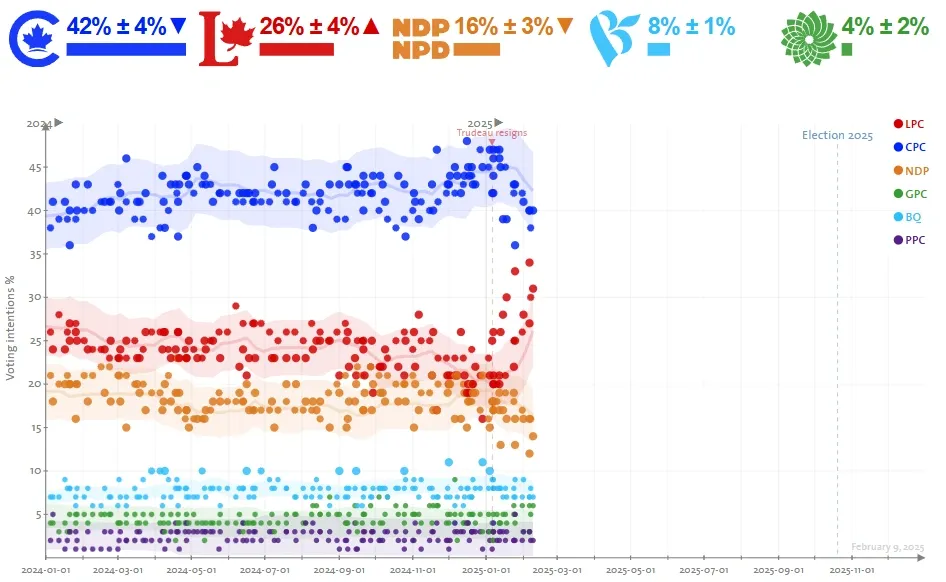
It’s no secret the Liberals are in the hole deep with some recent projections showing them getting Kim Campbelled. So the natural question is can Carney save the party from electoral oblivion? If selected as leader Carney has the distinct disadvantage of taking over an incumbent party and global elections have not been kind to incumbents recently. Additionally, arguing change from a position of incumbency is difficult; though it is not impossible it has even been done before by a few Liberal leaders. Recent evidence says maybe, since Trudeau has announced his departure the Liberals have been consistently ticking up in the polls. It is unclear as of yet, if this means that people like Carney or people didn’t like Pierre Polievre and just hated Trudeau (which is not an unbelievable hypothesis if you have ever had the displeasure of seeing or hearing Pierre Polievere). As of writing on February 12th, 2025 Leger has just released a poll that shows the Carney Liberals tied with the Conservatives if he is selected. Polls often receive a lot of criticism and some polls are undeniably bad but Leger in particular has a ranking of A+ by poll aggregator Canada 338 meaning their polls are accurate more often than not. What does this mean? Carney stands a decent chance of revitalizing the Liberal Party at least enough to avoid a conservative majority (Conservative minorities always become votes of no confidence about 10 minutes after the fact) and maybe even has a chance to pull things back enough to form another Liberal government.
What Can We Expect From the Fella as Prime Minister
What kinda thing can we expect from Carney if he becomes the top dog? Well, he’s a fella that likes to think about thinking. More specifically In terms of leadership style, we can expect a Prime Minister who thinks a lot about the context of actions not in just direct material outcomes but also in terms of social outcomes from differing perspectives. As stated before he views the objective of a leader to be a steward of an organization to achieve its purpose. Unsurprisingly the purpose of the Canadian government is to create the most common good possible and input and transparency are required to discern this good. He arrived at this conclusion in his book where he realizes what the elites see is not what the person on the ground sees; actions by the government should reflect the common good as perceived by as many perspectives as possible, not just elite perspectives. To do this he plans to make government transparency and accessibility central to governance to allow the greatest amount of input to be collected and trust to be built; this is mainly his solution to address the rising tide of the populist right while still being able to address issues like the literal rising tides of climate change. In crafting solutions and communication he believes leaders have to blend realism and optimism to govern he calls this Values Based Government. Striking that balance means that policy solutions must be effectively communicated and incorporate as many perspectives as possible, while also realizing sometimes a good solution now is better than a perfect one later. To facilitate communication with the public he would hold frequent forums to take questions on policy and then explain in detail why certain options are being taken or considered. He states that this style of communication should be similar to the constant two-way communication used by many governments during the early stages of the pandemic lockdowns.
This would be a nice change of pace for many as the Trudeau government is notoriously terrible at public communication (to such a degree I’m surprised they managed to remember to announce his resignation). For example, the Trudeau government has been heavily investing in many endeavours that are considered admirable to most Canadians like the expansion and modernization of the VIA rail network, yet nobody has heard. This has created a perception of nothing being done. By contrast, the Canadian government used to be very open and transparent. An example of this was Pierre Trudeau who was a grandmaster of openness and communication in government. Pierre Trudeau would frequently hold press conferences that had no purpose other than to explain an issue confronting the country and the options the government was thinking of pursuing including an honest look at policy strengths and drawbacks (there is also his extraordinary ability to talk to the press in a way completely foreign to modern leaders). This ended under Harper who kept the cabinet and government closed off from the media from which it has not recovered. It is worth mentioning the only time the current government engaged in communication with the public as intensively as Pierre Trudeau was when it hit its all-time popularity under COVID amid nearly daily prime ministerial addresses by Justin Trudeau. In conclusion, there is evidence communication should be central to governance to make it good and popular and Carney understands this completely.
In terms of policy, he has stated he will prioritize the economy first. His specific policy pledges thus far have been: Increasing competition in the Canadian private sector, prioritizing economic outcomes over spending levels, removing regulatory red tape impeding development, removing provincial trade barriers, reversing increases to the capital gains tax, incentivizing builders to build more homes for young Canadians, incentivizing green consumption on the consumer and producer end, Cutting taxes for the middle class, Reinforcing the supply chain, massive investment in the construction of railways, ports, roads, and bridges, and finally Increasing defence spending to the 2% NATO target. Which needless to say is the most generic list of Centrist Neo-Liberal policies that have ever been proposed and does not really seem to be much of a change at all for someone being touted as an extraordinary leader. In fact, Carney claims that mantel while embodying everything the liberals love in a leader is a miraculous display of unintentional irony. This list of policies makes our supposedly extraordinary leader very boring on a policy level. But hey, what did we expect from a banker…